The short answer
Your trapezius is one big, kite-shaped muscle that runs from the base of your skull, across the top of both shoulders, and down the middle of your back. Because it covers that much ground, no single stretch reaches all of it — but the part that almost always feels tight is the upper trapezius, the strip between your neck and the point of your shoulder.
The quickest release is an ear-to-shoulder tilt: sit tall, let one ear drop towards that shoulder, rest a hand lightly on your head and breathe. Hold it for 20–30 seconds, then swap sides. It needs no equipment and no warm-up mat, which is why it is the one most people can do straight from a desk chair.
The middle and lower parts of the muscle sit between and below the shoulder blades. They respond better to a cross-body arm stretch and an overhead reach against a wall — both covered in the steps below.
Before you start
A few small preparations make the difference between a stretch that helps and one that leaves you stiffer than before:
- Warm the area first. Muscles give more when they are warm, so stretch after a walk, a shower or a workout rather than first thing from a cold bed.
- Sit or stand tall. Slumping forward shortens the neck and makes the stretch feel sharper than it needs to.
- Keep your shoulders level. The commonest mistake is hitching the shoulder up towards the ear to meet the head.
- Clear the space around you so you can drop your arms and turn your head without catching anything.
- Nothing is required, though a folded towel under your forearm helps the cross-body stretch if your shoulder is stiff.
- Hold time
- 20–30 seconds per stretch, per side
- Repetitions
- 2–4 rounds per stretch
- Sessions
- 2–3 times a day, or whenever the neck feels tight
- Pressure
- The weight of your hand only — never pull on your head
- Breathing
- Slow and steady; do not hold your breath
- Stop signal
- Sharp pain, pins and needles, or dizziness
How to stretch your trapezius, step by step
-
01 /
Warm up for two minutes
Walk up and down the stairs, swing your arms loosely, or roll your shoulders slowly backwards ten times. A warm shower counts. If you are stretching straight after exercise, you can skip this.
-
02 /
Ear to shoulder for the upper trapezius
Sit or stand tall with your arms hanging loose. Let your right ear drop towards your right shoulder without lifting the shoulder to meet it. You should feel a pull along the left side of your neck and over the top of the shoulder — a stretch, not a pinch.
-
03 /
Add a light hand assist and adjust the angle
Rest your right hand on the left side of your head, fingers soft. Use only the weight of the hand. Tipping your nose a few degrees towards your left armpit biases the upper trapezius; looking slightly upwards shifts the pull towards the side of the neck instead. Choose whichever feels like the right spot.
-
04 /
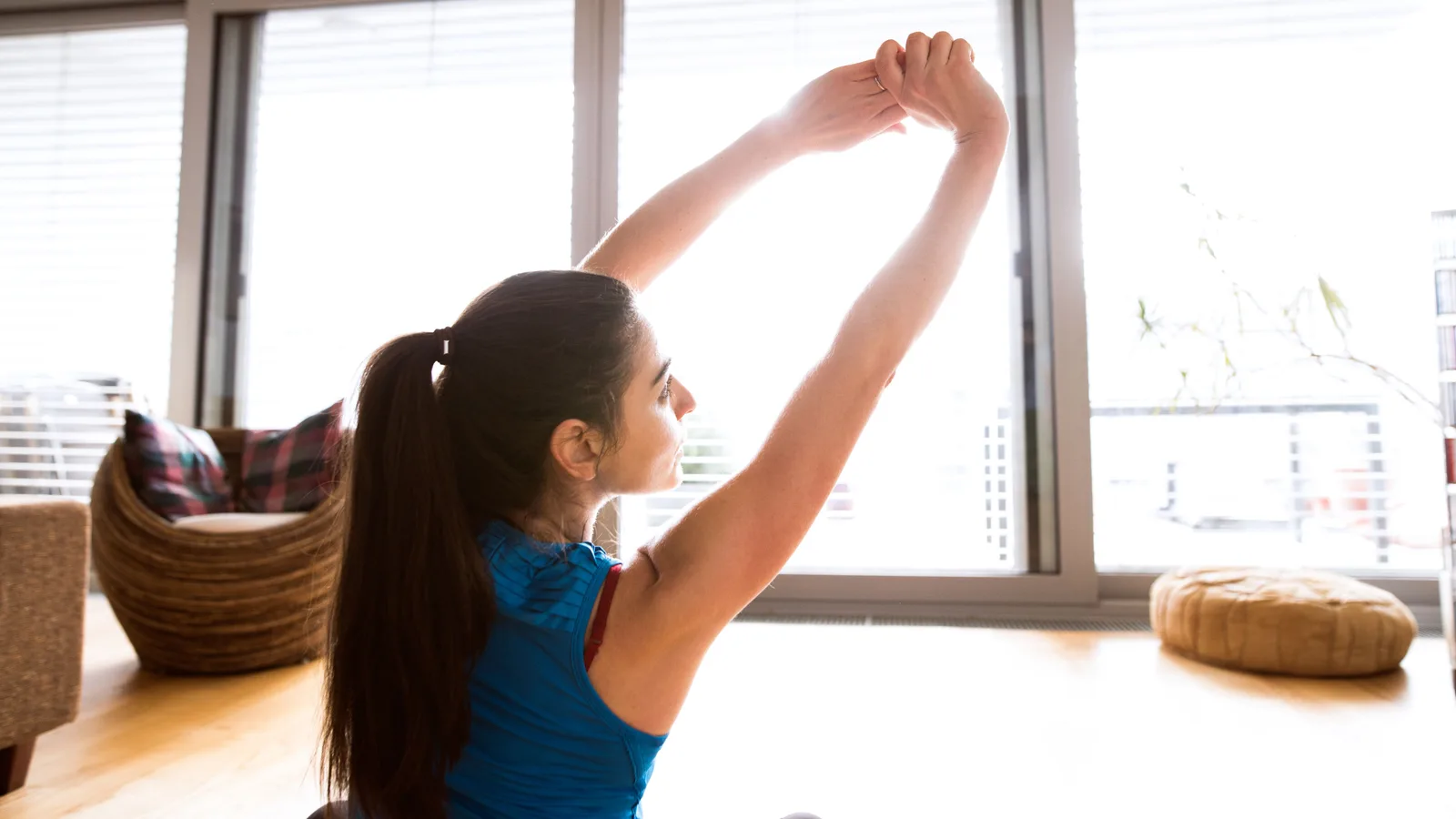
Cross-body stretch for the middle trapezius
Bring your right arm across your chest at shoulder height. Hook it with your left forearm above the elbow — not on the joint itself — and draw it gently closer. Keep the right shoulder pulled down and back rather than letting it roll forward, or the stretch disappears.
-
05 /
Overhead wall reach for the lower trapezius
Face a wall, feet hip-width apart, hands on the wall at shoulder height. As you walk your hands up and slightly wider, hinge forward from the hips with a flat back and your ribs down. Stop where you feel a pull between the shoulder blades, not in the lower back.
-
06 /
Breathe, hold and repeat on the other side
Hold for 20–30 seconds, breathing out slowly as you settle in. Come out of the stretch gradually rather than springing back, then repeat on the opposite side. Two to four rounds of each stretch is plenty.
Which part of the trapezius are you targeting?
| Part of the muscle | Where you feel it | Best stretch | Often driven by |
|---|---|---|---|
| Upper trapezius | Along the top of the shoulder and up the side of the neck | Ear to shoulder, nose slightly towards the armpit | Screen work, phone cradling, stress, heavy shoulder bags |
| Middle trapezius | Between the shoulder blades | Cross-body arm stretch | Rounded shoulders and long hours typing |
| Lower trapezius | Lower down between the blades, towards the spine | Overhead wall reach with a hip hinge | Prolonged sitting and weak shoulder-blade control |
If you are not sure which part is tight, work top to bottom: the ear-to-shoulder tilt first, then the cross-body stretch, then the overhead reach. Most people feel the strongest pull in the upper portion simply because that is where the muscle holds the most habitual tension.
How long to hold and how often
Short and frequent beats long and rare. A 30-second hold done three times a day does more for a tight neck than a five-minute session once a week, because the muscle is being reminded to lengthen rather than forced.
Do not bounce or pulse at the end of the range. Bouncing triggers a protective reflex that makes the muscle tighten, which is the opposite of what you want. Settle into the stretch, breathe out, and let the muscle ease on its own.
What commonly goes wrong
Most trapezius stretches fail for one of four reasons:
- Pulling on the head. The hand is there to add a little weight, not to drag the neck further. If you are pushing, ease off.
- Shrugging the shoulder up. The shoulder should stay heavy and low while the head moves towards it.
- Stretching into pain. A strong pull is fine; sharp, electric or burning sensations are not. Back off to where it is comfortable.
- Holding your breath. Tension in the neck often comes with shallow breathing. Slow exhalations help the muscle let go.
Why stretching alone often is not enough
What stretching does well
- Eases the feeling of tightness within a couple of minutes
- Needs no equipment and fits into a work break
- Helps you notice where you hold tension during the day
- Keeps the neck moving if you have been sitting for hours
What it will not do
- Build strength in the mid and lower trapezius
- Undo six hours a day of hunched sitting
- Give lasting relief if your desk setup stays the same
- Fix a shoulder problem on its own
Think of stretching as a reset, not a repair. If your shoulders creep up towards your ears all day, the muscle is being asked to work in a shortened position for hours; a 30-second stretch will not cancel that out. Raising your screen to eye level, bringing your keyboard closer, and adding some pulling and rowing movements for the upper back will do more for the underlying cause.
Desk habits that keep the shoulders down
Small changes hold the results of your stretching in place:
- Screen at eye level. Looking down all day is the single biggest driver of upper trapezius tension.
- Keyboard and mouse close enough that your elbows stay near your sides rather than reaching forward.
- Feet flat on the floor and hips slightly higher than the knees, so you are not propping yourself up on your shoulders.
- Headset for long calls instead of pinching a phone between ear and shoulder.
- Shoulder check every hour: roll them back and down once, then carry on.
When to see a GP or physiotherapist
Stretching is a reasonable first step for ordinary stiffness that eases with movement. It is not the right tool if the neck pain is severe, keeps waking you at night, follows an accident, or comes with headaches, visual changes, or any change in sensation in the arms.
If a few weeks of gentle, regular stretching and better desk habits have not helped, a physiotherapist can look at how your shoulder blades and neck move together and give you a targeted programme. In the UK you can usually self-refer to an NHS physiotherapy service, or book privately.
Frequently asked questions
Can you overstretch your trapezius?
Yes. Pulling on your head or holding a stretch for several minutes can irritate the joints of the neck and leave the muscle feeling tighter afterwards. Keep to gentle holds of no more than about 30 seconds and come out of the stretch while it still feels comfortable.
Why does my trapezius feel tight even after stretching?
Stretching changes how the muscle feels, not how much load it carries. If you spend the day with your shoulders raised or your head jutting forward, the tightness returns within hours. Adjusting your screen height and strengthening the upper back usually does more than adding extra stretches.
Should I stretch before or after exercise?
Save the static holds for after training or later in the day. Before lifting or sport, warm the area with slow shoulder rolls and arm swings instead; long holds immediately beforehand can temporarily reduce how much force the muscle can produce.
Is it safe to stretch with a painful neck?
Mild stiffness usually eases with gentle movement. Do not stretch if you have pins and needles or numbness in the arm or hand, feel dizzy, have had a recent whiplash injury, or the pain began after a fall. Speak to a GP or physiotherapist first.
How long before I notice a difference?
Most people feel looser straight after the first session. Lasting change usually takes two to three weeks of stretching two or three times a day alongside changes to how you sit and stand. If nothing has improved by then, get the area assessed.