The short answer
Your inner thigh muscles are the adductors: a group that runs from the pelvis down the inside of the thigh to the knee. Stretching them is simple, and you don't need to be flexible or own any kit to start.
The pattern is the same for every stretch: ease in until you feel a broad, warm pull along the inner thigh, hold for 20–30 seconds while breathing normally, then come out slowly. Two to three rounds per side. Do the gentler positions first and the deeper ones last, and give the whole routine 8–10 minutes, most days.
What you need before you start
Nothing specialist. The difference between a stretch you repeat and one you avoid is usually comfort, so spend a minute setting up:
- A clear patch of level floor, roughly 2 m by 1 m
- A mat, rug or carpet — hard floors are unforgiving on the sitting bones
- One firm cushion to sit on if your lower back rounds when your legs are wide
- A wall and a sturdy chair for the supported versions
- Ten unhurried minutes, ideally when you're already warm
- Floor space
- About 2 by 1 metres of clear, level floor
- Surface
- Mat, rug or carpet rather than bare boards or tiles
- Support
- One firm cushion, a wall and a sturdy chair
- Clothing
- Shorts or leggings you can move in; barefoot or in socks
- Time
- 10 minutes, plus 3–5 minutes to warm up
Warm up first, even for five minutes
Cold muscles resist a stretch, and resisting is exactly when people push too hard. Three to five minutes of easy movement is enough:
- March on the spot until you're slightly warm
- Swing each leg forwards and back ten times, holding the back of a chair
- Circle each hip slowly, five times in each direction
- Ten bodyweight squats or sit-to-stands from the chair
- Four or five slow side lunges, side to side
A brisk walk back from the shops counts as a warm-up too. What matters is that you aren't going straight from a desk chair into a deep straddle.
Six inner thigh stretches, in order
Work through these from gentlest to deepest. Stay in each for 20–30 seconds, rest for a few breaths and repeat two or three times on each side before moving on.
-
01 /
Seated butterfly
Sit on the floor or on a cushion with the soles of your feet together and your knees dropped out to the sides. Hold your ankles or shins, sit tall and hinge forward slightly from the hips. Let gravity open the knees rather than pressing them down with your hands. You should feel a broad pull along both inner thighs.
-
02 /
Lying straddle against a wall
Lie on your back with your sitting bones close to a wall and your legs resting up it. Let your legs open into a wide V, heels resting on the wall. Gravity keeps it gentle, so this suits stiff hips and anyone who finds sitting on the floor uncomfortable. Keep your lower back flat and your shoulders relaxed.
-
03 /
Standing side stretch at a chair
Stand beside a sturdy chair and rest one hand on the back. Step your outside foot out to the side with the toes pointing forward. Bend the standing knee a little, push your hips back and keep the extended leg straight with its foot flat on the floor. The stretch runs along the inner thigh of the straight leg. Keep both hip bones facing forward.
-
04 /
Wide-leg side lunge
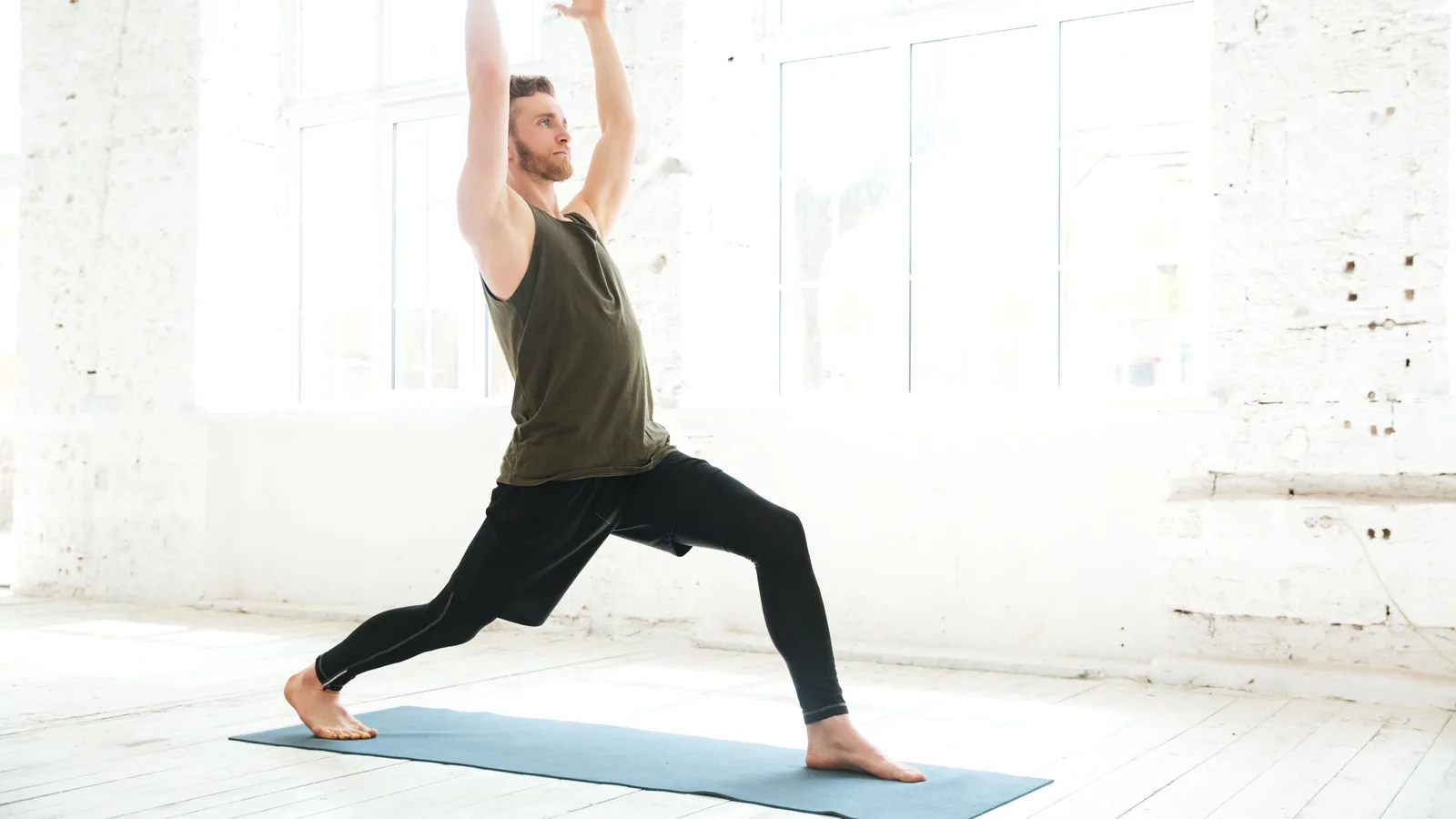
Stand with your feet wider than your hips, toes forward or turned out slightly. Shift your weight over one leg and bend that knee, keeping it in line with your toes while the other leg stays straight. Sink only as far as you can control. If the straight leg's heel lifts, shorten your stance rather than forcing the foot down.
-
05 /
Seated straddle with a tall spine
Sit with your legs wide and your knees and toes pointing up. Sit on a cushion if your lower back rounds straight away. Hinge forward from the hips and walk your hands forward only as far as your back stays long. If you're very tight, bend one knee in towards the other thigh and stretch one side at a time instead.
-
06 /
Frog stretch on all fours
From hands and knees, widen your knees as far as is comfortable with your feet in line with them and toes turned out. Shift your hips slowly back towards your heels and rest on your forearms or a cushion. This is the deepest stretch here: move in small amounts and come out as soon as you feel pinching rather than a pull.
How long to hold, and how often
- Hold each stretch
- 20–30 seconds, breathing normally
- Rounds
- 2–3 per side, per stretch
- Whole routine
- 8–10 minutes for all six stretches
- How often
- Most days; four days a week is a realistic minimum
- Best time
- After a workout, a walk or a warm bath
- Progress
- Add a little range or five seconds, not both at once
Frequency does more than duration. Five short sessions spread across the week beat one long, ambitious one that leaves you sore.
If you're very stiff, start with 15 seconds and only the first three stretches. Add the deeper positions after a fortnight, once the early ones feel easy. Progress by reaching a fraction further or holding slightly longer — never by bouncing or by asking someone to push you down.
What usually goes wrong, and the fix
- Bouncing at the end of the range. It triggers a protective reflex that makes the muscle tighten. Hold still and breathe out slowly instead.
- Pressing the knees towards the floor in butterfly. That's force, not stretch. Let the knees float where they land and lean forward instead.
- Rounding the back in seated straddles. You end up stretching the spine, not the thighs. Sit on a cushion and hinge from the hip crease with a long back.
- Starting with the frog stretch. It's the deepest position on the list and the easiest way to tweak a groin. Save it for last.
- Stretching cold, once a week. Warm up and spread the sessions out; the muscles respond to repetition, not heroics.
- Chasing symmetry. Most people are tighter on one side. Give both sides equal time and don't force the tighter one to match.
| What to check | Comfortable stretch | Stop and reassess |
|---|---|---|
| What you feel | A broad, warm pull along the muscle | Sharp, pinching or electric pain |
| Where you feel it | Inner thigh, between groin and knee | Front of the hip, lower back or behind the knee |
| Breathing | Slow and steady; you could speak | Held breath, tense jaw and shoulders |
| Knees | Tracking over the toes, no twisting | Collapsing inwards or a twisting sensation |
| The next morning | Slightly looser, no pain | Soreness lasting more than a day, or bruising |
Stretching is only half of it
If your inner thighs feel permanently tight, weakness is often part of the picture — the muscle works hard all day to stabilise the hip and then complains. Two or three strength exercises a week, done alongside the stretches, usually help more than stretching alone:
- Adductor squeeze: sit or lie with a firm cushion or rolled towel between your knees and squeeze for 5–10 seconds, ten times. Keep breathing.
- Side-lying leg lift: lie on one side with the top leg straight and lift it slowly ten times, keeping the hip stacked.
- Single-leg balance: stand on one leg at the kitchen counter for 20–30 seconds; it teaches the inner thigh to hold you steady.
A pinch at the front of the hip in wide-legged positions usually means the hip joint, not the muscle, has reached its limit. Narrow your stance rather than pushing through it.
When to stop, and who should get advice
Get advice from a GP or physiotherapist before stretching if you have a recent groin strain or hip injury, a hip replacement, joint hypermobility, knee problems, or pelvic girdle pain. During pregnancy, gentle stretching is usually fine, but hormones increase joint laxity — keep ranges small, avoid lying on your back for long stretches after the first trimester, and check with your midwife if you're unsure.
Don't stretch through an injury to "test" it, and don't use stretching as a substitute for assessment when pain is persistent, wakes you at night or comes with clicking or locking.
How to tell it's working
Forget centimetres and splits. The signs that matter are everyday ones: sitting cross-legged on the floor feels easier, getting out of a low car is less of a shuffle, and the first stretch of the session no longer feels like a wall.
Most people notice easier movement within two to four weeks of stretching most days. Larger range takes months and varies enormously between people. If nothing has changed after six weeks of consistent practice, or if one side stays painful, a physiotherapist can check whether the hip joint rather than the muscle is the limiting factor.
Inner thigh stretching: common questions
Should I stretch my inner thighs before or after exercise?
After is usually more comfortable, when the muscles are warm. Before a workout, use a few dynamic side lunges or leg swings rather than long static holds, which can temporarily reduce your power output.
Can stretching get rid of hip pain?
Not on its own. Muscular tightness sometimes contributes, but pain at the front of the hip, clicking, locking or pain when you bear weight needs assessment from a GP or physiotherapist rather than more stretching.
Will stretching slim my inner thighs?
No. Stretching improves range of motion and comfort, but it doesn't burn fat from a particular area — spot reduction isn't possible. Overall activity levels affect body composition far more.
How long before I notice a difference?
Most people find movement easier within two to four weeks of stretching most days. Bigger changes, such as a full straddle, take months and depend on your hip anatomy as much as on effort.
Is it normal for one inner thigh to be tighter?
Yes, most people have a difference between left and right. Give both sides the same time and don't force the tighter one to catch up. A persistent, painful difference is worth having checked.